Data Modeling in Practice: Grain, Facts, Dimensions, and Keys
Declaring grain, designing fact and dimension tables, choosing keys, and handling history — the decisions that make a warehouse answerable, with the code for each.
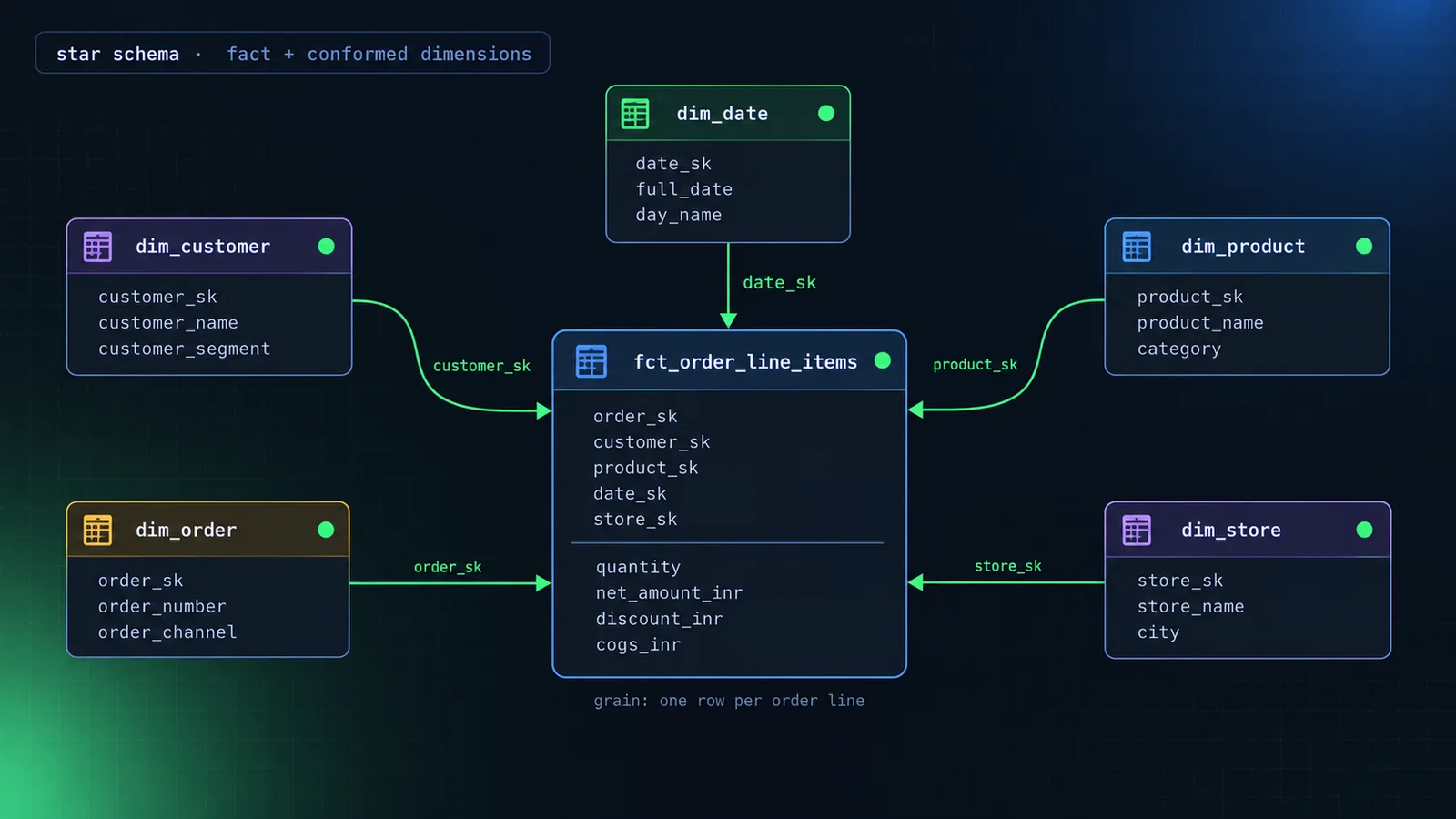
Here's a test you can run on any warehouse. Pick a table, find someone who didn't build it, and ask them what one row represents. If the answer takes longer than a sentence, or if two people give different answers, the table has a modeling problem — and every dashboard built on it inherits that problem, usually as numbers that are subtly, unfixably wrong.
Modeling is the least fashionable part of analytics engineering and the part that determines whether everything downstream works. Cheap storage and fast columnar warehouses have made it possible to skip, which is why so many teams do, and why so many teams end up with a metrics layer where the same question returns three answers depending on which table you start from.
This is a practical walkthrough of the decisions that actually make up a data model: declaring grain, designing fact and dimension tables, choosing keys, handling attributes that change over time, and picking a schema shape. Code examples are dbt and SQL, but the reasoning applies wherever you build.
Why This Still Matters When Storage Is Cheap
The argument against modeling goes: warehouses are fast now, joins are cheap, just dump everything wide and let analysts filter. It's not entirely wrong — the performance argument for dimensional modeling is much weaker than it was in 2005.
But performance was never the main point. The point is that a model encodes agreement. When fct_orders is defined as "one row per order line, after returns, excluding internal test accounts," that definition is written down once and every query inherits it. Without it, each analyst re-derives the definition in their own SQL, and the subtle differences between their versions become the reason finance and marketing report different revenue numbers in the same meeting.
A good model also makes questions answerable by people who didn't build it. That's the real deliverable: not a fast table, a legible one.
Declare the Grain, Before Anything Else
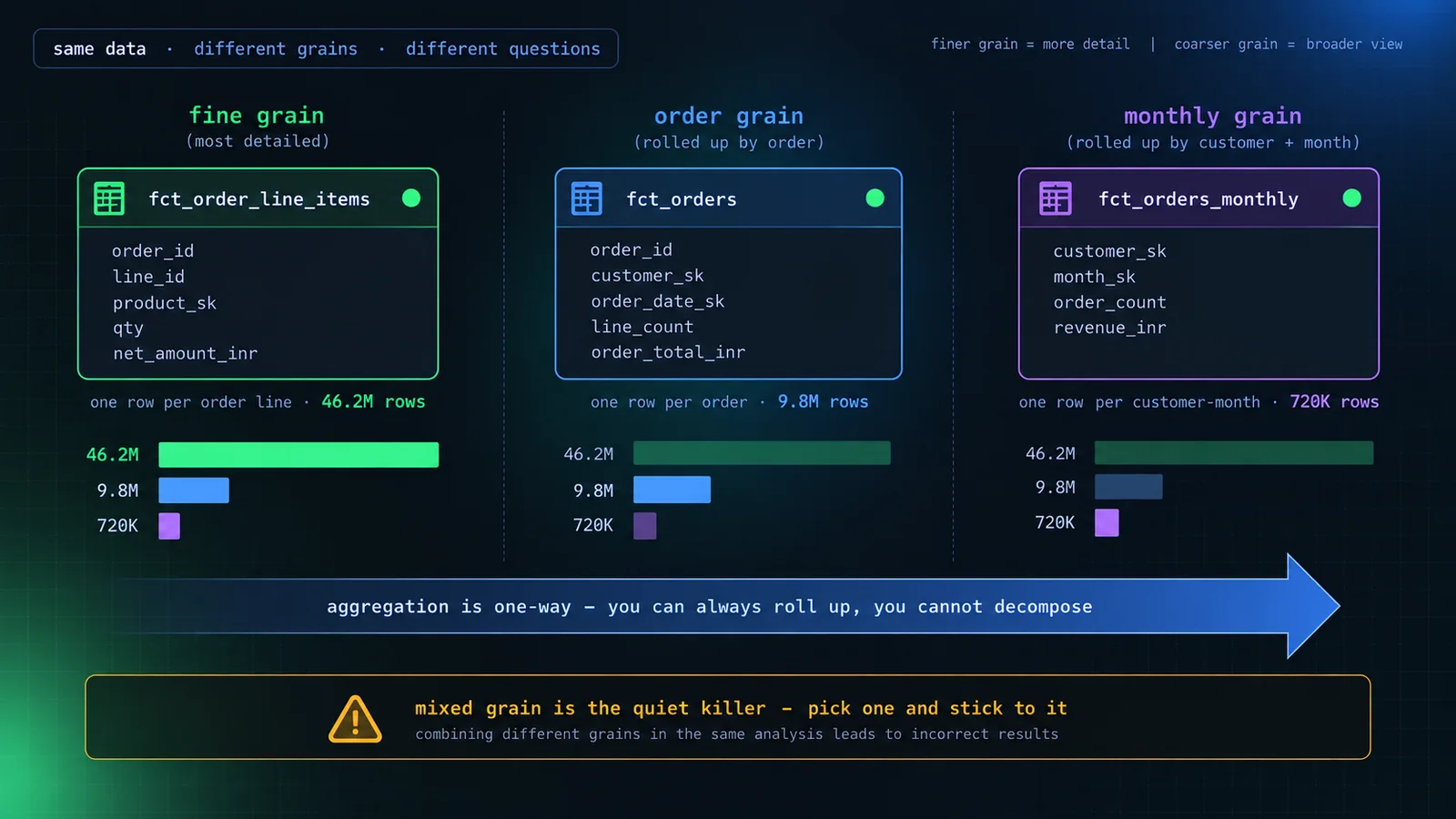
Grain is what a single row represents. It's the first decision, it constrains every subsequent one, and skipping it is the root cause of most broken models.
A grain statement should be one sentence with no "and also" in it:
- One row per order line item.
- One row per customer, per day.
- One row per support ticket state change.
Write it into the model's documentation, not just your head, so it's visible to whoever reads the table next:
models:
  - name: fct_order_items
    description: |
      Grain: one row per order line item.
      Includes cancelled orders (flagged, not filtered).
      Excludes internal test accounts.
    columns:
      - name: order_item_sk
        tests: [unique, not_null]
The reason grain comes first is that it determines what you're allowed to put in the table. A column only belongs if it's a genuine property of that grain. Order-level shipping cost does not belong on a line-item fact — not because it's unavailable, but because it's not a property of a line item, and putting it there means summing it across lines double-counts the shipping on every multi-line order.
the failure mode
Mixed grain is the quiet killer. A table where most rows are line items but order-level discount rows have been appended looks fine in a preview and produces wrong totals forever. If you find yourself adding a row_type column to distinguish what different rows mean, you have two tables wearing a trenchcoat.
Go finer than you think you need. You can always aggregate a fine-grained fact up; you cannot decompose a coarse one back down. Storage is the cheap part of this trade.
Fact Tables: Measurements and Foreign Keys
A fact table holds the things you measure, plus the keys that let you slice those measurements. Structurally it's narrow and long: a handful of numeric columns, a set of foreign keys, and a great many rows.
{{ config(materialized='incremental', unique_key='order_item_sk') }}

SELECT
    -- surrogate key for this grain
    {{ dbt_utils.generate_surrogate_key(['oi.order_id', 'oi.line_number']) }}
        AS order_item_sk,

    -- foreign keys to dimensions
    d.date_key             AS order_date_key,
    c.customer_sk,
    p.product_sk,

    -- degenerate dimension: kept on the fact, no dim table
    oi.order_id,
    oi.line_number,

    -- measures, all additive at this grain
    oi.quantity,
    oi.unit_price,
    oi.quantity * oi.unit_price  AS gross_amount,
    oi.discount_amount,
    oi.quantity * oi.unit_price - oi.discount_amount AS net_amount

FROM {{ ref('stg_order_items') }} oi
LEFT JOIN {{ ref('dim_customers') }} c ON oi.customer_id = c.customer_id
LEFT JOIN {{ ref('dim_products') }}  p ON oi.product_id  = p.product_id
LEFT JOIN {{ ref('dim_dates') }}     d ON oi.order_date  = d.date_day
order_id there is a degenerate dimension — an identifier that's genuinely dimensional but has no attributes of its own worth a separate table, so it lives on the fact. Perfectly normal, and better than creating a dim_orders containing nothing but an ID.
the three fact types
- Transaction facts — one row per event, at the moment it happened. The default, and what most people mean by "fact table." Insert-only, never updated.
- Periodic snapshot facts — one row per entity per period, capturing state. Account balance per customer per day. Predictable size, and the right answer for anything where "what was it on that date" matters more than individual events.
- Accumulating snapshot facts — one row per process instance, with columns for each milestone, updated as the process advances. An order with
ordered_at,picked_at,shipped_at,delivered_atin one row. Ideal for pipeline and lag analysis, and the one fact type that genuinely gets updated in place.
additivity is a property you have to check
Not every number can be summed. Additive measures sum across all dimensions — revenue, quantity. Semi-additive measures sum across some but not time — an account balance can be summed across customers, but summing a balance across days is meaningless. Non-additive measures can't be summed at all: ratios, percentages, unit prices.
The practical rule is to store the components and derive the ratio at query time. Storing margin_pct on a fact guarantees someone eventually averages it and reports a number that doesn't match margin computed properly. Store revenue and cost; let the metric layer divide.
Dimension Tables: Context, Denormalized
Dimensions hold the descriptive attributes you filter and group by. They're wide and short — many columns, comparatively few rows — and they should be flat. Where normalization says to split category into its own table, dimensional modeling says to flatten it in.
{{ config(materialized='table') }}

SELECT
    {{ dbt_utils.generate_surrogate_key(['p.product_id']) }} AS product_sk,
    p.product_id,                       -- natural key, kept for joins/debugging

    p.product_name,
    p.sku,

    -- hierarchy flattened in, not snowflaked out
    c.category_name,
    c.department_name,
    b.brand_name,
    b.supplier_name,

    -- useful derived attributes belong here too
    CASE WHEN p.list_price < 500  THEN 'budget'
         WHEN p.list_price < 5000 THEN 'mid'
         ELSE 'premium' END AS price_band,
    p.is_active

FROM {{ ref('stg_products') }} p
LEFT JOIN {{ ref('stg_categories') }} c ON p.category_id = c.category_id
LEFT JOIN {{ ref('stg_brands') }}     b ON p.brand_id    = b.brand_id
That price_band column is doing real work. Derived attributes belong in the dimension precisely so that every analyst uses the same buckets — the moment the definition lives in individual queries instead, you get four incompatible definitions of "premium."
three patterns worth knowing
Conformed dimensions are dimensions shared across multiple fact tables. If dim_customers is used by both fct_orders and fct_support_tickets, you can compare order volume against ticket volume by the same customer segment. This is the single highest-value property of a dimensional model, and it only works if you resist the urge to build dim_customers_for_support.
Role-playing dimensions are one physical dimension referenced several times with different meanings. A date dimension joined as order date, ship date, and delivery date. Expose them as views with prefixed column names so a query reading ship_date_month is unambiguous.
Junk dimensions collapse a scatter of low-cardinality flags — is_gift, is_expedited, payment_type — into one small dimension of distinct combinations, replacing several columns on the fact with a single key. Worth doing when the flags start multiplying; not worth doing for three of them.
A date dimension deserves special mention: build one, always, covering more years than you think you need. Fiscal periods, holiday flags, and week-start conventions are business logic, and business logic belongs in a table rather than being re-derived with date functions in every query.
Keys: Natural, Surrogate, and the Unknown Member
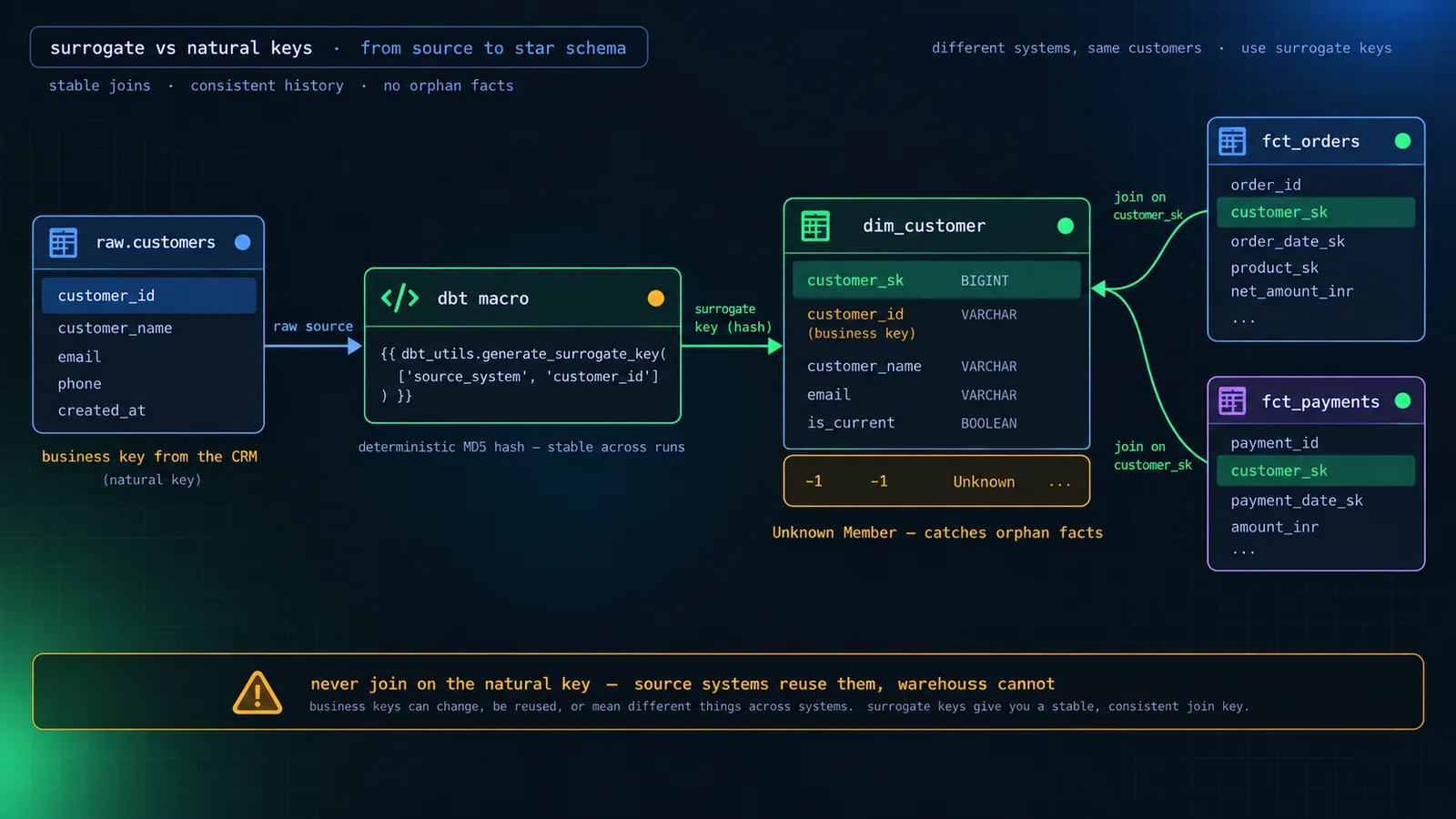
Every dimension has a natural key — the identifier the source system uses. Most should also have a surrogate key, a warehouse-generated identifier that the facts actually join on.
The reasons for the extra key are practical rather than theoretical. Natural keys change: a system migration renumbers customers, an acquisition introduces ID collisions, a source switches from integers to UUIDs. They're also often composite, which means every fact table carries three columns to identify one dimension row. And critically, tracking history requires a key that can distinguish two versions of the same entity — which a natural key, by definition, cannot.
-- current-state dimension: key on the natural key alone
{{ dbt_utils.generate_surrogate_key(['customer_id']) }} AS customer_sk

-- historised (SCD2) dimension: include the validity start
{{ dbt_utils.generate_surrogate_key(['customer_id', 'valid_from']) }} AS customer_sk

-- composite grain on a fact
{{ dbt_utils.generate_surrogate_key(['order_id', 'line_number']) }} AS order_item_sk
Hash-based keys have a real advantage over sequences in a distributed warehouse: they're deterministic. The same inputs produce the same key on any machine, in any order, on a full refresh or an incremental run — so a rebuild doesn't renumber everything and orphan your facts. Always hash a normalized input, though: trailing whitespace or inconsistent casing produces two keys for one entity.
the unknown member
Facts arrive referencing dimension rows that don't exist yet — a late-arriving product, a null customer on a guest checkout. If you inner join, those facts silently vanish and your revenue total is quietly short. If you leave the key null, outer joins spread nulls through every report.
The fix is a designated unknown row in every dimension:
-- in the dimension: append a known sentinel row
SELECT ... FROM real_products
UNION ALL
SELECT '-1' AS product_sk,
       'UNKNOWN' AS product_id,
       'Unknown product' AS product_name,
       'Unknown' AS category_name

-- in the fact: never emit a null key
coalesce(p.product_sk, '-1') AS product_sk
Now unmatched facts are visible rather than missing. "Unknown product: ₹40,000" in a report is a data quality bug someone will fix. A revenue total that's ₹40,000 short with no indication why is a bug nobody will ever find.
Slowly Changing Dimensions: Keeping the Past
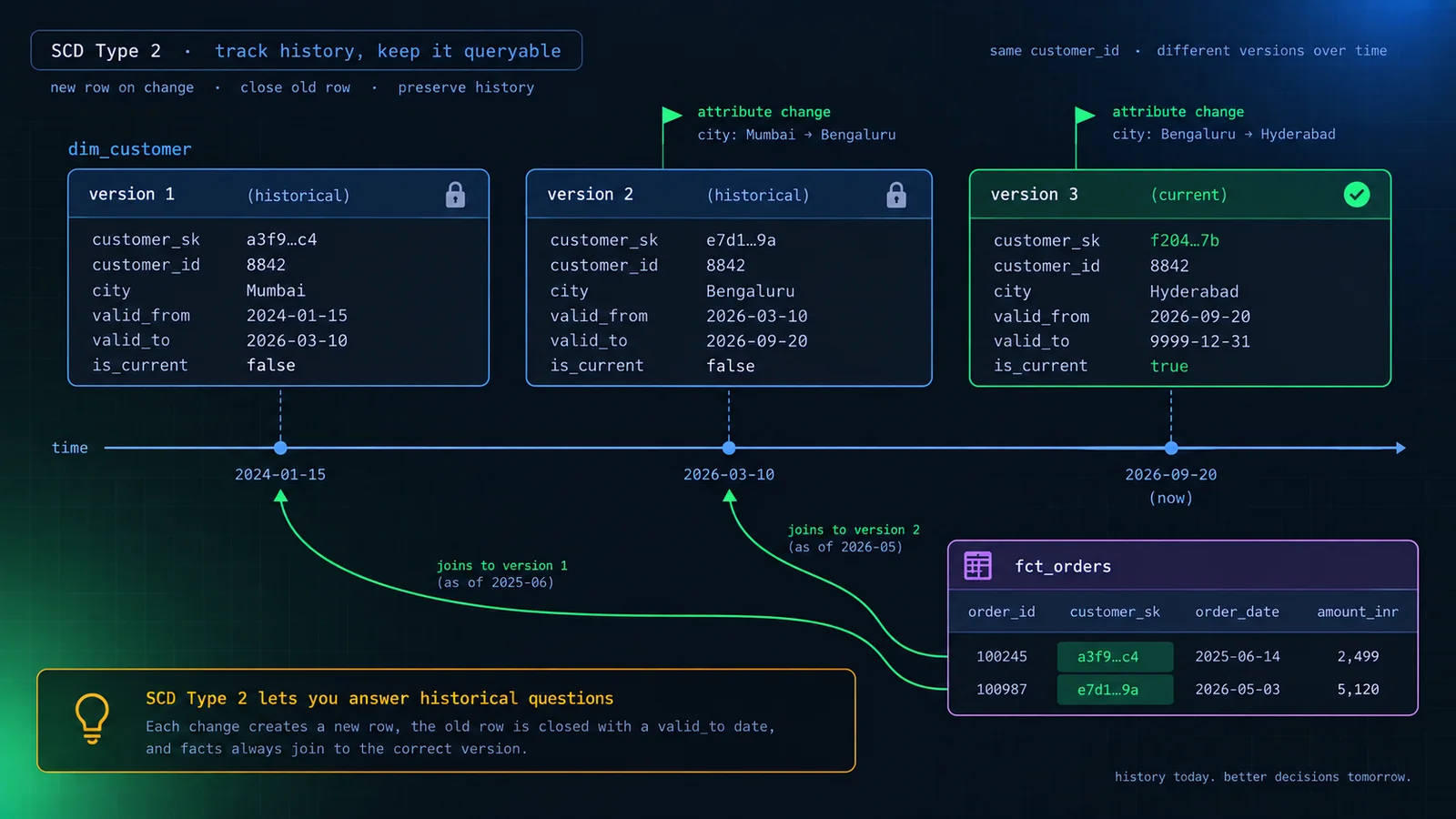
Customers move cities. Products get recategorised. Sales reps change territory. The question every dimension eventually has to answer is: when an attribute changes, what happens to the rows that referenced the old value?
| Type | Behavior and when to use it |
|---|---|
| Type 0 | Never changes. Original signup date, original acquisition channel — attributes where the historical value is the meaning. |
| Type 1 | Overwrite. History is lost. Correct for genuine corrections — a misspelled name was never true and shouldn't be preserved. |
| Type 2 | New row per version, with validity dates. The workhorse. Use for anything where past reports must stay reproducible. |
| Type 3 | Add a previous_value column. Holds exactly one prior version. Narrow use: a single reorganisation where both old and new groupings need reporting. |
In dbt, Type 2 is handled by snapshots rather than models, because it needs to capture change as it happens rather than derive it after the fact:
{% snapshot customers_snapshot %}

{{ config(
    target_schema='snapshots',
    unique_key='customer_id',
    strategy='check',
    check_cols=['city', 'segment', 'plan_tier']
) }}

SELECT * FROM {{ source('raw', 'customers') }}

{% endsnapshot %}
Note that check_cols lists only the attributes worth versioning. Snapshotting every column means a new row every time last_login_at updates, which turns a dimension into an event log and makes joins much more expensive.
the join people get wrong
A Type 2 dimension has multiple rows per natural key, so joining a fact to it on the natural key alone multiplies your rows. The fact must join on the surrogate key captured at event time, or — if you only have the natural key — on the key and the validity window:
SELECT
    f.order_id,
    f.net_amount,
    c.segment          -- segment as it was on the order date
FROM {{ ref('fct_orders') }} f
JOIN {{ ref('dim_customers_scd') }} c
  ON f.customer_id = c.customer_id
 AND f.order_ts >= c.dbt_valid_from
 AND f.order_ts <  coalesce(c.dbt_valid_to, '9999-12-31')
That coalesce on the open-ended row is not optional — dbt_valid_to is null for the current version, and a plain < comparison against null drops every current row, which is a bug that passes tests and fails in production.
One thing snapshots can't do: recover history you didn't capture. They record changes from the moment you start running them. If historical tracking might matter later, start snapshotting now, even before anyone has asked for it.
Star, Snowflake, or One Big Table
Three shapes, and the choice is less about performance than about who maintains the thing.
A star schema is a fact table surrounded by flat dimensions, each one join away. This is the default recommendation and has been for thirty years, because it's the shape that's simultaneously efficient for the warehouse and legible to a human reading the ERD.
A snowflake schema normalizes those dimensions into sub-dimensions — product joins to category joins to department. It saves storage that nobody needs saved, and costs every query an extra join plus every analyst an extra thing to remember. Reach for it only when a hierarchy is genuinely volatile and shared across many dimensions.
A one big table approach pre-joins everything into a single wide denormalized table. It's genuinely the right answer sometimes: BI tools that handle joins badly, or a specific high-traffic dashboard where query simplicity outranks everything. The costs are real though — an attribute change means rebuilding a huge table, storage multiplies with repetition, and because each OBT is built for one purpose, you end up with several that disagree.
The pattern that works well in practice is a star schema as the source of truth, with OBTs built from it for specific consumers. The wide tables become disposable derivatives rather than the thing you maintain.
Where the Methodologies Fit
You'll encounter three names. Kimball is dimensional modeling as described above — facts and conformed dimensions, built bottom-up by business process. It's what most analytics teams do, and everything in this article is essentially Kimball with modern tooling.
Inmon builds a normalized enterprise warehouse first, with dimensional marts derived from it. More up-front work, stronger consistency guarantees, and a reasonable fit for large organisations with many source systems and heavy governance requirements.
Data Vault splits everything into hubs (keys), links (relationships), and satellites (attributes, historised). It's built for auditability and source-system churn, and it's genuinely good at both. It also produces a lot of tables and is close to unusable for direct analysis, so it sits as a raw layer with dimensional marts on top.
Most teams should start with Kimball and only add complexity when a specific pressure demands it. Choosing Data Vault before you have the regulatory or multi-source problem it solves is a common and expensive mistake.
Testing a Model
Modeling assumptions should be enforced, not just documented. Four tests cover most of the ways a dimensional model breaks:
models:
  - name: fct_order_items
    columns:
      - name: order_item_sk
        tests: [unique, not_null]          # grain is what you said it is

      - name: customer_sk
        tests:
          - not_null                       # unknown member, never null
          - relationships:               # no orphaned facts
              to: ref('dim_customers')
              field: customer_sk

      - name: net_amount
        tests:
          - dbt_utils.expression_is_true:
              expression: ">= 0"
The unique test on the surrogate key is the important one: it's a direct, automated assertion that your grain statement is true. If it fails, the table means something different from what its documentation says, which is the most dangerous state a model can be in.
A Decision Framework
Starting a new mart? → Write the grain sentence first, in the YAML, before any SQL. If you can't write it cleanly, the scope is wrong.
Measuring events as they happen? → Transaction fact, insert-only, at the finest grain available.
Need "what was the state on date X"? → Periodic snapshot fact, one row per entity per period.
Tracking something through stages with lag analysis? → Accumulating snapshot, one row per process instance, updated in place.
Attribute changes and old reports must stay correct? → SCD Type 2 via snapshot. If old reports should update, Type 1.
Same dimension needed by two facts? → Conform it. One dim_customers, not one per consumer.
A BI tool or dashboard that struggles with joins? → Build an OBT from the star, and treat it as disposable.
Common Mistakes
Never declaring grain. Everything else follows from it. A table without a stated grain accumulates columns that don't belong until nobody can safely aggregate it.
Mixing grains in one table. Order-level and line-level rows in the same fact double-counts anything summed. The tell is a row_type column.
Storing ratios instead of components. Percentages and averages can't be re-aggregated. Store numerator and denominator; divide at query time.
Inner joining facts to dimensions. Silently drops unmatched rows. Use an unknown member and a left join, so gaps are visible instead of invisible.
Joining an SCD2 dimension without its validity window. Multiplies fact rows by the number of versions. Always include the date-range predicate, and always coalesce the open-ended valid_to.
Building a dimension per consumer. dim_customers_marketing and dim_customers_finance guarantee the two teams will eventually report different numbers for the same segment.
Snapshotting every column. A new dimension version every time a timestamp ticks turns a dimension into an event log. List only the attributes worth versioning.
Putting It Together: A Realistic Layout
models/
├── staging/                     -- 1:1 with sources, rename + cast only
│   ├── stg_orders.sql
│   ├── stg_order_items.sql
│   └── stg_customers.sql
├── intermediate/                -- reusable joins, not exposed to BI
│   └── int_orders_with_returns.sql
└── marts/
    ├── dim_dates.sql            -- date spine, built once, used everywhere
    ├── dim_customers.sql        -- conformed, current state
    ├── dim_customers_scd.sql    -- Type 2, built on the snapshot
    ├── dim_products.sql         -- flattened hierarchy, derived bands
    ├── fct_order_items.sql      -- transaction, one row per line item
    ├── fct_customer_daily.sql   -- periodic snapshot, one row per cust/day
    └── fct_order_pipeline.sql   -- accumulating snapshot, one row per order

snapshots/
└── customers_snapshot.sql       -- check strategy, 3 versioned columns
Two things in that layout are worth pointing at. dim_customers and dim_customers_scd coexist deliberately: most queries want the current state and shouldn't pay for validity-window logic, while the historised version exists for the reports that genuinely need point-in-time accuracy. Building both from one snapshot keeps them consistent.
And all three fact types appear, because they answer different questions about the same orders. The transaction fact answers "how much did we sell," the daily snapshot answers "what did this customer look like in March," and the accumulating snapshot answers "how long does fulfilment actually take." Trying to make one table do all three is how tables end up with mixed grain.
Wrapping Up
Dimensional modeling has outlasted several generations of warehouse technology because the problem it solves isn't technological. Storage got cheap and joins got fast, and neither of those changed the fact that a team needs one agreed definition of what a customer is and what an order means.
The practical core is short. State the grain in one sentence and write it down. Keep facts narrow and additive, storing components rather than ratios. Keep dimensions wide, flat, and conformed across facts. Use surrogate keys, and give every dimension an unknown member so bad joins are loud instead of silent. Snapshot the attributes whose history matters, before anyone asks for it. And test the grain, because a grain statement nobody enforces is a comment, not a guarantee.
Do that, and the warehouse becomes answerable — which is the only property that actually matters, because a fast table nobody understands is worth considerably less than a slow one they do.
— This article is part of an ongoing tooling series on techedge.in. Stuck on a grain decision? Drop a comment, I read every one.
One email, every other week.
New posts on data engineering, applied AI, and the business decisions around them. No noise, unsubscribe anytime.
Comments
All comments are reviewed before they appear publicly — this keeps spam out.
Loading comments…