Data Warehouse vs. Data Lake vs. Data Mart vs. Data Mesh: Key Differences & Trade-offs
Four terms that get thrown around almost interchangeably in job postings and vendor decks, and almost never mean the same thing. Here's what each one actually is, where each one wins, and what it actually costs you to choose one.
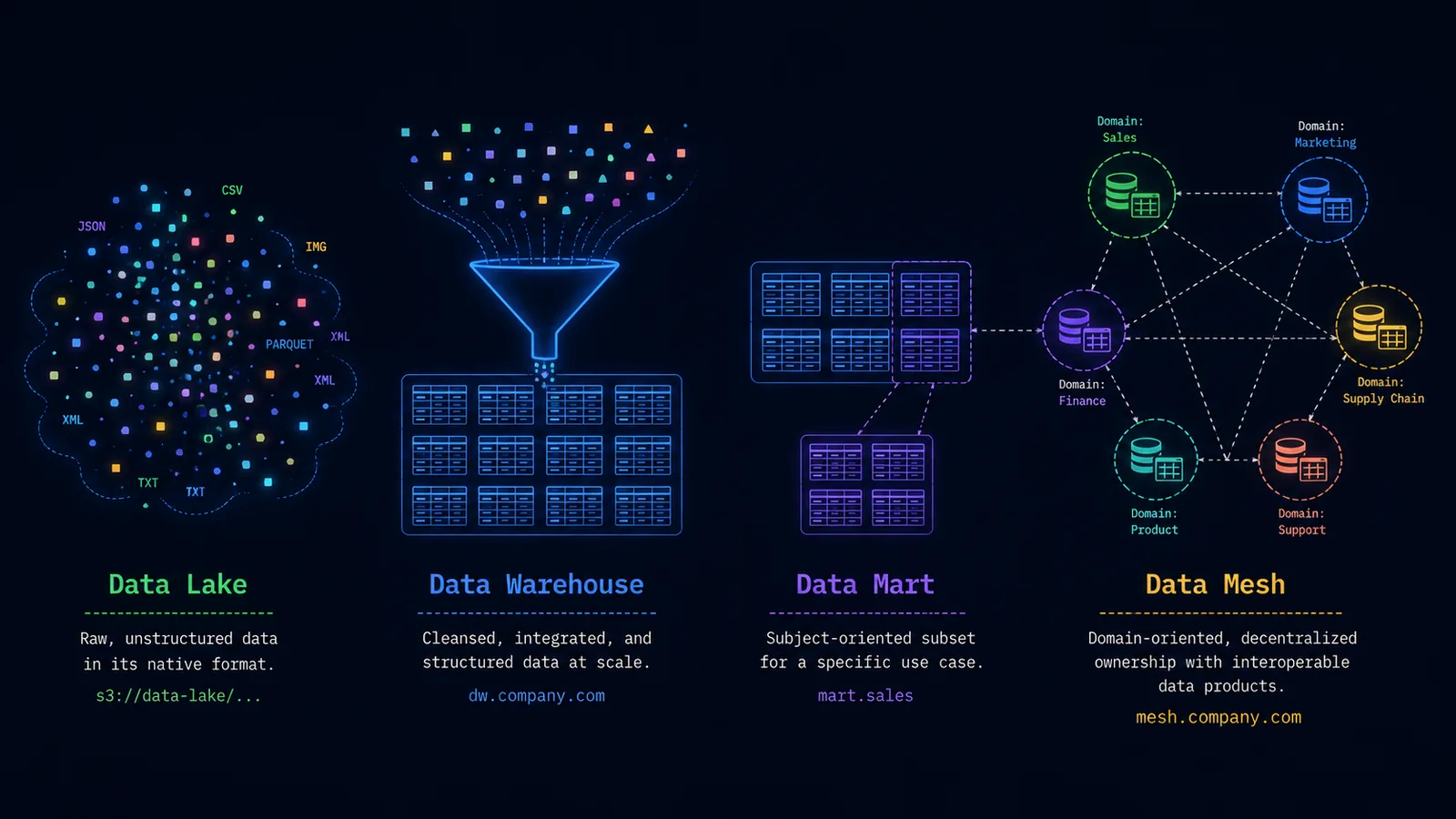
Sit in on enough data architecture discussions and you'll notice the same four words get used as if they're roughly synonymous, then get defended as if they're bitterly opposed, sometimes in the same meeting. "We need a data lake" turns into "don't you mean a warehouse?" turns into "actually, shouldn't each team just own its own domain?" Vendors don't help — plenty of platforms happily market themselves as all four at once, which is technically defensible and completely unhelpful if you're trying to figure out what your organization actually needs.
These four terms describe genuinely different things: different storage assumptions, different intended users, different governance models, and — this is the part that actually matters when you're the one making the decision — genuinely different trade-offs. This article walks through what a data warehouse, data lake, data mart, and data mesh each actually are, where each one is the right call, and what you give up by choosing one over the others. A fifth pattern, the data lakehouse, gets its own section too, since it's become common enough in the last few years that leaving it out would be a real gap.
Why This Comparison Keeps Coming Up
The confusion isn't really about definitions — it's about the fact that all four solve overlapping pieces of the same underlying problem: getting the right data, in a usable shape, to the right people, without either drowning them in noise or starving them of what they need. Where they differ is in which piece of that problem they optimize for.
A data warehouse optimizes for trustworthy, structured, fast-to-query business data. A data lake optimizes for capturing everything, in whatever shape it arrives, cheaply, so nothing is lost before anyone's decided what it's for. A data mart optimizes for a specific team's speed and simplicity, at the cost of generality. A data mesh optimizes for organizational scale — specifically, for the moment a single centralized data team can no longer keep up with the number of domains that need data work done, and ownership has to spread out instead of bottlenecking.
None of these are strictly "better" than the others in the abstract, which is exactly why the debate keeps resurfacing — the right answer depends entirely on the shape of the organization asking the question, not on which pattern is newest or most talked about at the moment.
What a Data Warehouse Actually Is
A data warehouse is a centralized repository built specifically to store structured, cleaned, business-ready data, optimized for fast analytical queries across large volumes of historical records. The defining trait isn't the technology underneath — it's the discipline: data entering a warehouse has typically already been validated, conformed to a known schema, and modeled around how the business actually asks questions, before anyone runs a report against it.
This is the "schema-on-write" world. You decide the structure — the tables, the column types, the relationships — before data lands, which means every query against a warehouse can assume the data is already in a known, trustworthy shape. That upfront discipline is exactly what makes warehouses fast and reliable for BI dashboards, financial reporting, and any workload where "the number needs to be right and needs to load in under two seconds" matters more than flexibility.
CREATE TABLE analytics.fct_orders (
    order_id        VARCHAR NOT NULL,
    customer_id     VARCHAR NOT NULL,
    order_date      DATE    NOT NULL,
    order_status    VARCHAR NOT NULL,
    order_total     NUMERIC(12,2) NOT NULL,
    currency_code   VARCHAR(3)  NOT NULL,
    PRIMARY KEY (order_id)
);
Traditional warehouses (Teradata, Oracle Exadata) ran on-premises with tightly coupled compute and storage. Modern cloud warehouses — Snowflake, BigQuery, Redshift, Databricks SQL Warehouses — separate the two, so storage and compute can scale independently, but the core promise is unchanged: structured, governed, fast, and trustworthy, at the cost of needing to know your schema before data can land.
What a Data Lake Actually Is
A data lake is a centralized repository that stores data in its raw, native format — structured, semi-structured, or entirely unstructured — at low cost and effectively unlimited scale, without requiring a predefined schema before ingestion. Where a warehouse insists on structure up front, a lake defers that decision entirely: JSON event logs, CSV exports, Parquet files, images, audio, PDFs, and clickstream data can all land in the same lake side by side, exactly as they arrived from the source.
This is "schema-on-read" — the structure gets applied at query time, by whatever tool or process is reading the data, not baked in at ingestion. That flexibility is the entire point: a lake lets an organization capture everything now and decide later what any of it is actually for, which matters enormously for use cases a rigid warehouse schema was never designed to anticipate — training a machine learning model, doing exploratory analysis on raw clickstream, or archiving sensor data from IoT devices nobody's fully speced out a report for yet.
s3://raw-lake/ecommerce/orders/2026/08/01/orders_00001.json
s3://raw-lake/ecommerce/clickstream/2026/08/01/events_00001.parquet
s3://raw-lake/support/tickets/2026/08/01/tickets_raw.csv
s3://raw-lake/iot/sensor-readings/2026/08/01/readings.avro
The trade-off is real, though, and it's the one every "data lake" horror story traces back to: without discipline around organization, cataloging, and access control, a lake degrades into what the industry bluntly calls a data swamp — a sprawling pile of files nobody can find, trust, or safely query, where "we have the data somewhere" stops meaning anything useful. A lake buys flexibility and cost efficiency; it does not, on its own, buy governance or trust — those have to be deliberately layered on top.
What a Data Mart Actually Is
A data mart is a focused, smaller-scope subset of a data warehouse, built around the needs of a single business function or department — finance, marketing, sales, supply chain — rather than the entire organization. If a warehouse is the full, enterprise-wide picture, a mart is a curated slice of it, pre-joined and pre-aggregated around exactly the questions one team asks repeatedly.
Marts exist for a simple, practical reason: not every analyst needs, or should have, unrestricted access to every table in the enterprise warehouse, and not every query should have to re-derive the same joins and business logic from scratch. A finance mart might expose a handful of clean, well-documented tables — revenue by region, cost center rollups, AR aging — instead of forcing a finance analyst to hunt through hundreds of warehouse tables and reconstruct "recognized revenue" correctly on their own.
models:
  - name: fct_revenue_by_region
    description: "Finance mart: recognized revenue rolled up by region and month."
    columns:
      - name: region
        tests: [not_null]
      - name: revenue_month
        tests: [not_null]
      - name: recognized_revenue
        tests:
          - dbt_expectations.expect_column_values_to_be_between:
              min_value: 0
The Kimball approach to warehousing traditionally built marts as the primary user-facing layer, sitting on top of a conformed dimensional model — the warehouse existed largely to feed the marts. Modern cloud-warehouse practice, especially in dbt-centric stacks, tends to treat marts more loosely: a "mart" is often just the department-facing layer of models within a single warehouse, using shared staging and intermediate models underneath rather than a physically separate database. Either way, the core idea hasn't changed — narrower scope, closer to how one team actually thinks, at the cost of being genuinely useful to that team and nobody else.
The Lakehouse — a Hybrid Worth Knowing
No comparison of these patterns is complete without the data lakehouse, which emerged specifically to close the gap between lakes and warehouses rather than picking a side. A lakehouse stores data in open file formats in cheap object storage — the lake's core strength — while adding a transactional metadata layer (Delta Lake, Apache Iceberg, Apache Hudi) on top that provides warehouse-grade guarantees: ACID transactions, schema enforcement, time travel, and fast SQL query performance directly against that same storage.
The practical pitch is straightforward: stop maintaining two separate copies of data — one messy copy in the lake for data science, one clean modeled copy in the warehouse for BI — and instead let both workloads query the same underlying files. Platforms like Databricks and increasingly Snowflake (via Iceberg support) have leaned hard into this model over the past few years, and it's become the default architecture for a meaningful share of new builds specifically because it removes the "which copy is the real one" question that plagued lake-plus-warehouse setups.
The trade-off is maturity and complexity: lakehouse table formats are powerful but younger than traditional warehouse engines, and getting warehouse-grade query performance out of object storage still generally requires more careful tuning — partitioning, file compaction, clustering — than a fully managed cloud warehouse asks of you out of the box.
What a Data Mesh Actually Is
Here's where the comparison changes shape entirely. A warehouse, a lake, and a lakehouse are all, fundamentally, storage and processing patterns — you can point at a piece of infrastructure and say "that's the warehouse." A data mesh isn't a storage technology at all. It's an organizational and architectural philosophy for how data ownership and responsibility should be distributed across a company, first articulated by Zhamak Dehghani, that can be implemented on top of a warehouse, a lake, a lakehouse, or a mix of all three.
The core diagnosis behind mesh is organizational, not technical: in a large company, a single centralized data team eventually becomes the bottleneck for every domain that needs data work done, because that team has to understand marketing's data, finance's data, supply chain's data, and product's data equally well to serve all of them — and it never quite can. Mesh's answer is to stop centralizing data ownership at all, and instead treat each business domain as responsible for producing, owning, and serving its own data as a first-class, well-documented "data product," the same way a domain team already owns its own microservice or application.
| In a centralized model | In a mesh |
|---|---|
| One central data team models everyone's data | Each domain team models and owns its own data |
| Consumers request pipelines from the central team | Domains publish self-serve, documented data products |
| Quality is the central team's responsibility | Quality is the producing domain's responsibility |
| Standards are whatever the central team enforces | Standards are set federally, enforced consistently across domains |
This is why mesh gets described as much more of an organizational change than a tooling one — adopting it well requires clear domain boundaries, real platform investment so domain teams aren't reinventing infrastructure from scratch, and a level of data engineering maturity spread across many teams rather than concentrated in one. It's also why mesh tends to only pay off at real organizational scale; deploying it inside a company with one central data team of six people mostly just recreates the same coordination problem with extra ceremony.
Warehouse vs. Lake — the Core Differences
Schema Timing: Write-Time vs. Read-Time
This is the single most consequential difference between the two. A warehouse enforces schema-on-write — the structure is decided and validated before data is allowed in, which is exactly why warehouse queries are fast and predictable: the engine already knows precisely what shape every table is in. A lake enforces schema-on-read — data lands as-is, and structure gets applied only when something actually queries it, which means ingestion is nearly frictionless but every consumer has to independently figure out, or trust someone else's documentation of, what the data actually looks like.
The practical consequence: a warehouse is where you go when you already know the questions you'll be asking repeatedly and want them answered fast and reliably. A lake is where you go when you don't yet know all the questions, and want the option to ask new ones later without having re-ingested anything.
Data Shape: Structured vs. Everything
Warehouses are built almost exclusively for structured, tabular data — rows and columns, the format SQL and BI tools were designed around. Lakes accept anything: structured exports, semi-structured JSON and XML, and fully unstructured content like images, audio, video, and free text. This is the reason machine learning teams and data scientists gravitate toward lakes for training data — a model training pipeline often needs raw, unaggregated, occasionally non-tabular inputs that a warehouse's rigid schema was never designed to hold economically.
Cost, Users, and Failure Mode
Object storage underneath a lake is dramatically cheaper per terabyte than warehouse compute-attached storage, which is a big part of why "store everything in the lake, model only what's needed in the warehouse" became such a common two-tier pattern. Warehouses are typically used directly by analysts and BI tools; lakes are typically used by data engineers, data scientists, and ML pipelines, with a much smaller share of business users ever querying the raw lake directly. And the failure modes differ sharply — a warehouse failure usually looks like a query timing out or a dashboard erroring out loudly; a lake failure usually looks quiet and much worse: a slow accumulation of undocumented, untrusted files nobody can confidently use, discovered only when someone goes looking for something specific and can't tell which of six similarly named files is authoritative.
Where Marts Fit Into Either One
Data marts aren't a competing architecture to warehouses and lakes — they're a scoping decision layered on top of one, usually a warehouse, though nothing stops a mart-style layer from sitting on top of a lakehouse too. The relevant question for a mart is rarely "warehouse or lake," it's "how narrow should this dataset be, and who exactly is it for."
Two flavors show up in practice. A dependent mart is built from an already-conformed enterprise warehouse — the Kimball-style approach — inheriting the warehouse's shared definitions and simply narrowing scope for one team. An independent mart is built directly from source systems without a shared warehouse underneath it, which is faster to stand up for a single urgent need but risks exactly the "four different definitions of monthly active users" problem that shared, warehouse-level modeling exists to prevent. Independent marts are a reasonable shortcut for a genuinely standalone, low-stakes need; they're a real long-term liability when built for a metric that other teams will eventually also need to report on.
The Four Principles Behind Mesh
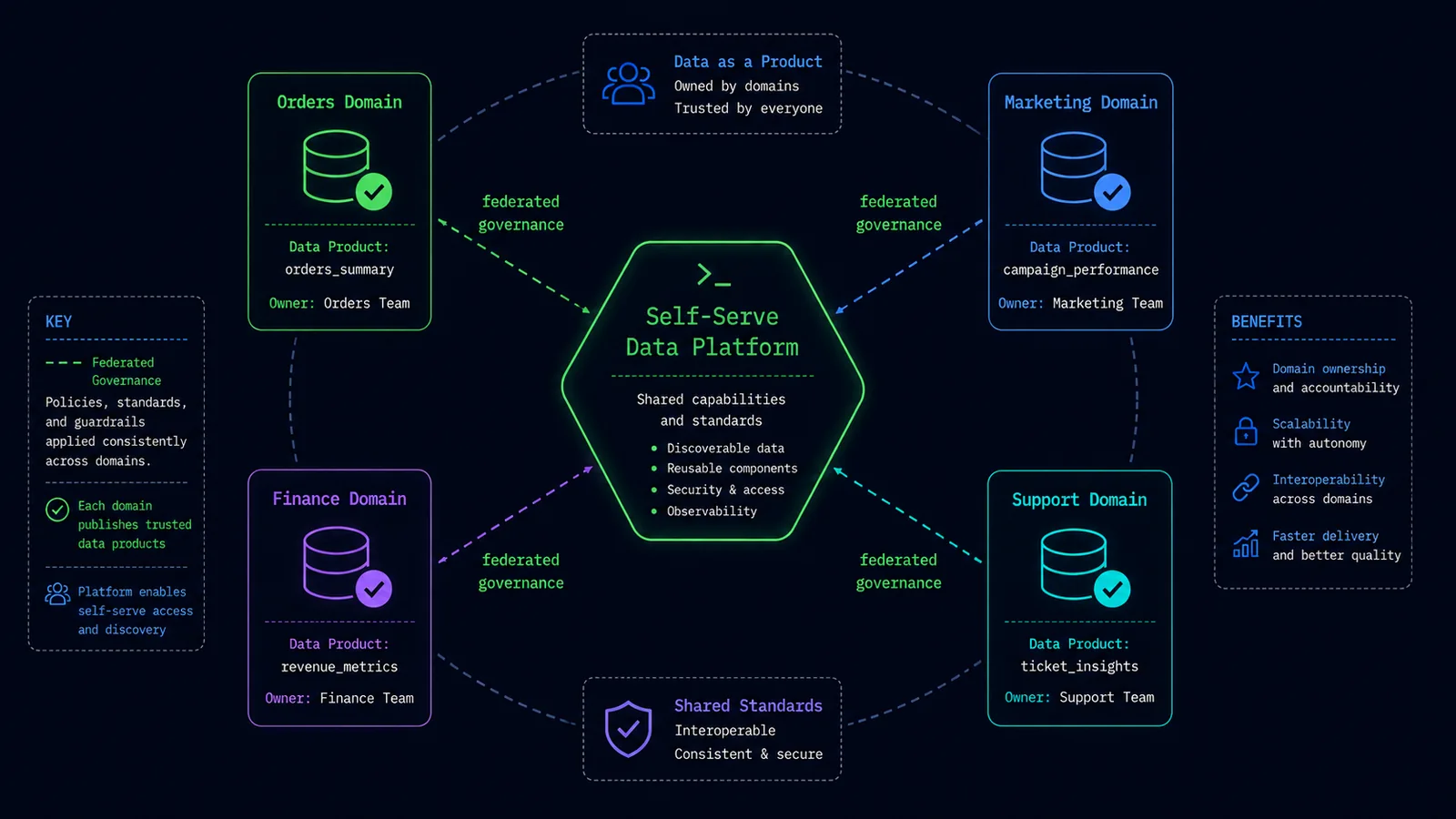
Zhamak Dehghani's original framing breaks data mesh down into four principles, and it's worth walking through each one concretely, since "mesh" gets used loosely enough in the industry that the actual substance behind it is easy to lose.
1. Domain-oriented ownership
Data about orders is owned by the team that owns orders; data about shipping is owned by the team that owns shipping. Each domain is responsible for its own data the same way it's responsible for its own service's uptime — not handed off to a separate, central team the moment it needs to be analytics-ready.
2. Data as a product
A domain's output isn't a database dump — it's a documented, discoverable, quality-guaranteed data product, with an owner, a defined interface, SLAs, and the same care a public API would get. Concretely, this often means each domain maintains its own dbt project (or equivalent), publishing clearly named, tested, documented models other teams can safely build on:
models:
  - name: orders_data_product
    description: "Owned by the Orders domain. SLA: refreshed hourly, 99.5% freshness target."
    meta:
      owner: orders-team@company.com
      sla_hours: 1
    columns:
      - name: order_id
        tests: [unique, not_null]
3. Self-serve data platform
For domain teams to realistically own data products without each reinventing pipeline infrastructure from scratch, a central platform team still exists — but its job shifts from building pipelines to building the shared tooling (ingestion frameworks, cataloging, access controls, observability) that lets domain teams self-serve. This is the piece organizations most often underfund when adopting mesh, and it's usually why early mesh attempts stall.
4. Federated computational governance
Domains own their data, but standards — naming conventions, security policies, interoperability formats, quality thresholds — are still set collectively and enforced consistently, often through automated policy checks built into the shared platform rather than a central team manually reviewing every domain's output.
All Four, Side by Side
| Dimension | Data warehouse | Data lake | Data mart | Data mesh |
|---|---|---|---|---|
| What it is | Structured, centralized storage | Raw, centralized storage | Scoped subset of a warehouse | Organizational/architectural pattern |
| Schema | Schema-on-write | Schema-on-read | Schema-on-write, narrow | Defined per domain |
| Data types | Structured only | Structured, semi-, unstructured | Structured only | Whatever each domain handles |
| Primary users | Analysts, BI tools | Data engineers, data scientists | One department's analysts | Cross-domain consumers |
| Ownership | Central data team | Central data/platform team | Central team, department-scoped | Individual domain teams |
| Cost profile | Higher per TB, fast queries | Low per TB, cheap storage | Small, inherits warehouse cost | Distributed across domain budgets |
| Best at scale | Small to large orgs | Any org with varied data types | Any org with distinct departments | Large orgs with many domains |
| Biggest risk | Rigid, slow to extend | Becoming a data swamp | Fragmented, duplicated logic | Under-invested platform, inconsistent quality |
Which One Is Right for Your Use Case
"Which is best" is the wrong question — the honest answer to almost every version of it is "it depends what you're optimizing for right now," and the table below is meant to make that concrete rather than dodge it.
| If your priority is... | Reach for... | Because |
|---|---|---|
| Reliable BI dashboards and financial reporting | Data warehouse | Fast, trustworthy, structured queries are exactly what it's built for |
| Capturing raw event/clickstream/log data cheaply | Data lake | Low-cost storage, no schema decisions needed up front |
| Training machine learning models on varied inputs | Data lake (or lakehouse) | Handles unstructured and semi-structured data natively |
| A single department needs fast, simple self-serve reporting | Data mart | Narrow scope, pre-modeled around that team's exact questions |
| Avoiding two separate copies of the same data | Data lakehouse | One storage layer serves both BI and data science workloads |
| A central data team can't keep up with dozens of domains | Data mesh | Distributes ownership so no single team is the bottleneck |
| A small company or single data team of a handful of people | Data warehouse (plus marts as needed) | Mesh's coordination overhead outweighs its benefit at this scale |
Note that most of these aren't mutually exclusive choices in practice — a very common real-world setup is a lake or lakehouse for raw and semi-structured capture, feeding a warehouse (or the warehouse layer of a lakehouse) for modeled, business-ready data, with marts scoped on top for individual departments, and mesh principles layered over the whole thing once the organization is large enough that domain ownership genuinely helps rather than adds friction.
The Real Trade-offs
Every choice here trades something specific away. Being explicit about what, rather than treating any one pattern as strictly superior, is what actually helps in a real planning conversation.
Flexibility vs. reliability
A lake's flexibility — accept anything, decide structure later — is bought directly at the cost of the reliability a warehouse's upfront schema enforcement provides. You cannot have both maximal flexibility and maximal guaranteed structure in the same layer; lakehouses narrow this gap but don't eliminate it.
Cost vs. query performance
Lake storage is cheap; warehouse-grade query performance against structured, indexed, pre-aggregated data generally isn't free. Lakehouse table formats have closed much of this gap, but tuning object storage for genuinely fast interactive BI queries still typically takes more deliberate engineering effort than a managed cloud warehouse asks for out of the box.
Centralized consistency vs. domain autonomy
A centralized warehouse team can enforce one consistent definition of "revenue" across the whole company — at the cost of becoming a bottleneck as the company grows. A mesh removes that bottleneck by distributing ownership — at the cost of needing real, deliberate federated governance to keep "revenue" from quietly meaning five different things across five domains. Neither problem disappears; mesh trades one failure mode for a different one.
Speed to value vs. long-term maintainability
An independent data mart, or a quick lake dump with no cataloging, gets a team unblocked fast. Both accumulate technical and organizational debt if they're never revisited — the independent mart drifts from the shared warehouse's definitions, and the uncatalogued lake dump becomes the "does anyone know what this file is" problem a year later.
Organizational readiness vs. architectural ambition
This is the trade-off most often ignored, and it's the one behind the most failed mesh rollouts: mesh asks every domain team to absorb real data engineering responsibility. An organization without the appetite, tooling investment, or domain team maturity to take that on will get most of mesh's coordination overhead and very little of its benefit — the pattern's value is conditional on organizational readiness, not automatic.
A Worked Reference Architecture
To make all four patterns concrete together rather than abstractly, here's a common layered setup that combines them — a medallion-style lakehouse feeding a warehouse-style modeled layer, with department marts on top, structured so that a mesh-style ownership model could be layered over it later without a rebuild.
# bronze — raw lake layer, schema-on-read, exactly as received
s3://lakehouse/bronze/orders/          # raw JSON from source system
s3://lakehouse/bronze/clickstream/     # raw event logs

# silver — cleaned, deduplicated, typed, still domain-oriented
s3://lakehouse/silver/orders/          # Delta/Iceberg tables, validated schema

# gold — warehouse-style, business-modeled, mart-scoped
warehouse.marts_finance.fct_revenue_by_region
warehouse.marts_marketing.fct_campaign_attribution
In this layout, the bronze and silver zones behave like a data lake — cheap, flexible, schema-on-read for bronze, lightly structured for silver. The gold zone behaves like a warehouse, or the warehouse-facing layer of a lakehouse, fully modeled and business-ready. The marts_finance and marts_marketing schemas are data marts, scoped narrowly to each department. And if the orders and clickstream pipelines were each owned end-to-end by their respective domain teams — publishing silver and gold layers as documented, SLA-backed data products rather than a central team owning all of it — this same physical layout would already satisfy the core of a data mesh, without changing a single storage technology. That's the point worth taking away: mesh is a change in who's accountable for which layer, not necessarily a change in what the layers themselves look like.
Choosing and Migrating Without Regret
Start from your actual bottleneck, not the pattern's popularity. If nobody's complaining about a slow central team and BI dashboards are the main need, a straightforward warehouse plus a couple of marts is very often correct — resist the pull toward mesh or a lakehouse just because they're the more talked-about pattern this year.
Don't build a lake without a cataloging plan from day one. The gap between "a lake" and "a data swamp" is almost entirely governance discipline — naming conventions, a data catalog, and clear ownership tags — not the storage technology itself.
Prefer dependent marts over independent ones by default. Build marts on top of shared, conformed warehouse models whenever a metric is likely to matter to more than one team, even if an independent mart would be faster this week.
Don't adopt mesh principles before investing in the self-serve platform. Handing domains ownership without giving them real tooling just relocates the bottleneck instead of removing it — fund the platform piece first, or at the same time, not after.
Treat these as layers, not a single choice. Most mature setups blend a lake or lakehouse for raw capture, a warehouse layer for modeled data, marts for departmental scoping, and mesh-style ownership once the org is large enough — pick the combination that matches your actual scale and team structure, not one pattern in isolation.
Free places to go deeper
- Zhamak Dehghani's original writing on data mesh — the primary source for the four principles, free to read online
- Databricks' and Snowflake's own documentation on lakehouse table formats (Delta Lake, Iceberg) — the fastest way to see current tooling maturity
- Ralph Kimball's dimensional modeling material — still the clearest grounding for how marts and conformed warehouses relate
- Public architecture write-ups from engineering blogs at companies that have migrated between these patterns — genuinely useful for seeing real trade-offs, not vendor pitches
The Bottom Line
A data warehouse, a data lake, a data mart, and a data mesh aren't four competing answers to the same question — they're answers to four different questions that happen to all fall under "how should we handle data." A warehouse answers "how do we make structured business data fast and trustworthy to query." A lake answers "how do we capture everything cheaply before we've decided what it's for." A mart answers "how do we make this specific team's slice of the data as simple as possible to use." And a mesh answers a question the other three don't even attempt to answer on their own: "how do we keep data ownership from bottlenecking on one team as the company grows."
Most real organizations end up needing pieces of all four eventually, layered rather than chosen exclusively — the actual skill isn't picking the single "correct" pattern, it's recognizing which question your organization is actually stuck on right now, and reaching for the layer that answers that one, without assuming it has to solve the other three at the same time.
— This article is part of an ongoing tooling series on techedge.in. Weighing a specific migration between these patterns and want a second opinion? Drop a comment, I read every one.
One email, every other week.
New posts on data engineering, applied AI, and the business decisions around them. No noise, unsubscribe anytime.
Comments
All comments are reviewed before they appear publicly — this keeps spam out.
Loading comments…